Interactive WorkReach Model
Explore how distance, economic complexity (ECI), and informality shape work location choices across Mexican states. Adjust parameters to see how mobility flows change in real-time.
Why do we work where we work?
If you think about it for a moment, deciding where to work is one of the decisions that shapes our daily lives the most. It defines how much time we spend commuting, what time we wake up, how much we spend on transportation, and even how much time we have left to be with our family or to rest. And it's almost never an easy decision, because on one hand we want our job to be close, but on the other hand the best opportunities are often far from where we live.
In Mexico City we live this every day. You probably know someone (or maybe it's you) who crosses the city from the east side or from the State of Mexico to get to work in Santa Fe, Polanco, or downtown, spending hours on the metro, the bus, or the microbus, simply because that's where the jobs are.
In urban planning and transportation there are classic models to estimate how many people travel from one place to another, like the gravity model (which, as the name says, is inspired by Newton's gravity) or the radiation model. These models are very good at predicting how many trips there are between two places, but they tell us very little about why people make those decisions. And that was exactly what I wanted to understand. So we developed WorkReach, a model that tries to understand how people balance distance against the quality of job opportunities, also taking into account the informality of the area where they live. Below I go over the general results and, as always, you can find the full paper at the end of this text.
How do we measure how good a job is?
This is one of my favorite parts of the project. To measure the quality of job opportunities we used economic complexity, which basically measures how diverse and sophisticated the economic activities of an area are. You might think the easiest thing would be to use wages, but wages only tell us how much a job pays today. Complexity tells us more about what the place has to offer. In areas where lots of different industries live side by side there are more kinds of jobs, it's easier to find one that fits you, and you also learn more from what's going on around you.
On the other side there's informality, meaning jobs that are outside official records and don't come with social security. In Latin America informality is part of everyday life, but in the United States it's barely studied, even though it's there too. That's why we picked four cities of similar size, two in Latin America (Mexico City and Rio de Janeiro) and two in the United States (Los Angeles and the San Francisco Bay Area), so we could compare them.
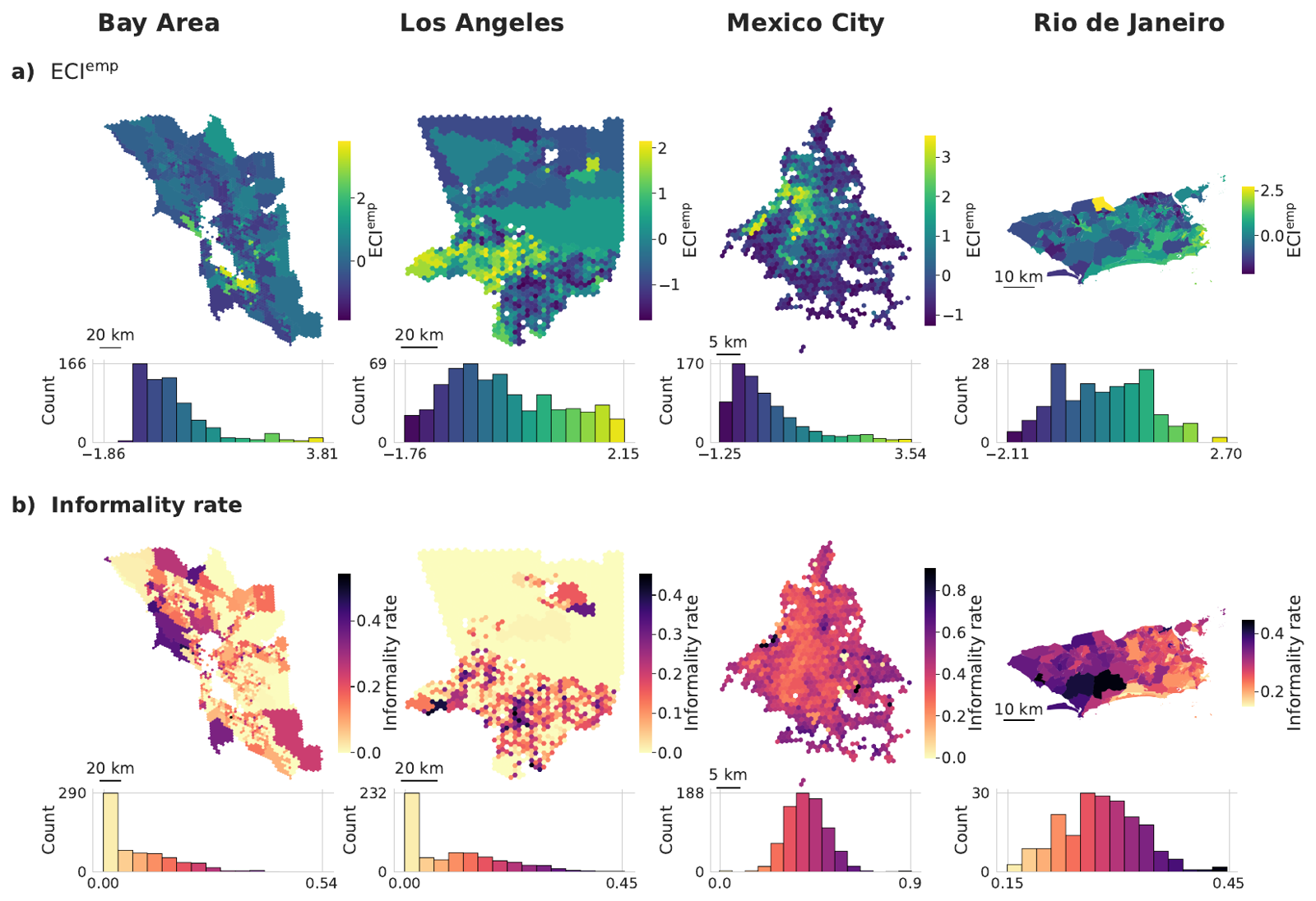
Top, the economic complexity of each area. Bottom, the informality rate of the people who live there.
Something you can already see in the maps is that in Mexico City and Rio, the areas with more informality tend to be far from the areas with more economic complexity. In Los Angeles and the Bay Area that relationship basically doesn't exist, and informal workers are more mixed across the city. And you can see this in commutes too. In the Latin American cities, the longest commutes are made by people who live in areas with high informality and work in areas with high complexity. In the U.S. cities it's the other way around, and the longest commutes are made by people from low-informality areas, who live in the suburbs and travel to the job centers.
The model
The idea behind WorkReach is pretty simple. Imagine that each person, from their home, can choose among every place in the city to go to work, and that they pick the one that gives them the most "utility", which is something like the satisfaction they get from that option. That utility goes down the farther away the job is, goes up the more complex the destination area is, and the informality of the area where the person lives changes how worth it is to go far.
We also added something that for me is key. Close to home, what matters most is that the job is nearby. As jobs get farther away, people start paying more attention to the quality of the opportunity. In the model this isn't an on/off switch but a gradual transition, an S-shaped curve (a sigmoid) that controls how much complexity and informality weigh in at each distance. Very close to home they weigh little, and far away they weigh in fully. The model finds on its own where the middle of that curve is, meaning the distance at which complexity already counts for half of its full effect, and how abrupt the transition is. In Mexico City that midpoint is around 16 km and in Rio around 25 km, and the transition is gradual, so complexity already matters well before those distances, just less than it does farther out. In the U.S. cities the midpoint is very close to home and the transition is sharp, so complexity counts fully almost right away, which makes sense with their highways, car use, and the habit of living in houses in the suburbs, far from the job centers.
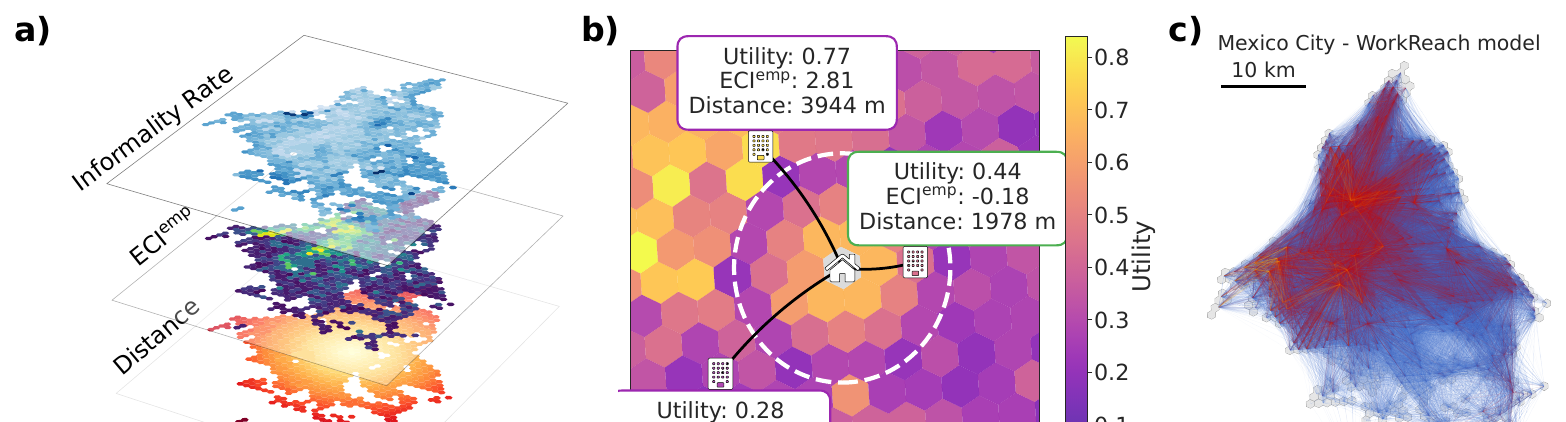
How WorkReach works in Mexico City. The dashed circle marks the midpoint of the transition, the distance at which the quality of the job already counts for half of its full weight. Inside the circle it still counts, just less, and outside it keeps growing until it counts fully.
What did we find?
In all four cities people prefer short commutes, which is no surprise. But in all four, people are also willing to travel farther to work in areas with more economic complexity. The interesting part is how much farther. For example, someone in Mexico City is willing to travel almost four times the distance for the same increase in complexity as someone in Los Angeles, and Rio is the city where people are most willing to make that trade. Another way to see it is that in Mexico City, if a job is 1% farther away than an otherwise identical one, the probability of choosing it drops by about 3.7%.
Something really interesting happens with informality, because its effect flips depending on the region. In Mexico City and Rio, living in an area with high informality goes hand in hand with being more willing to travel far to reach high-complexity areas. One possible explanation is that jobs in those areas tend to be formal, so even if the position isn't specialized, it comes with social security and benefits, and on top of that there are few job options close to home in the peripheries. In Los Angeles and the Bay Area it's the opposite, and people from areas with more informality are less willing to make long trips. Keep in mind that these are all relationships we see in the data and not causes, because we're looking at a snapshot of commutes at one point in time.
How well does it predict?
Even though the main idea of WorkReach is to understand decisions and not just to predict, we also wanted to know if it predicts well. So we compared it with the classic gravity and radiation models, and with a gravity-like model found by a symbolic regression algorithm (the Bayesian Machine Scientist). To measure it we used the CPC, which is roughly the fraction of trips the model puts in the right place. WorkReach predicts just as well as the others, and in the Bay Area it's actually the best. The difference is that with WorkReach, besides knowing how many trips there are, we can understand why.
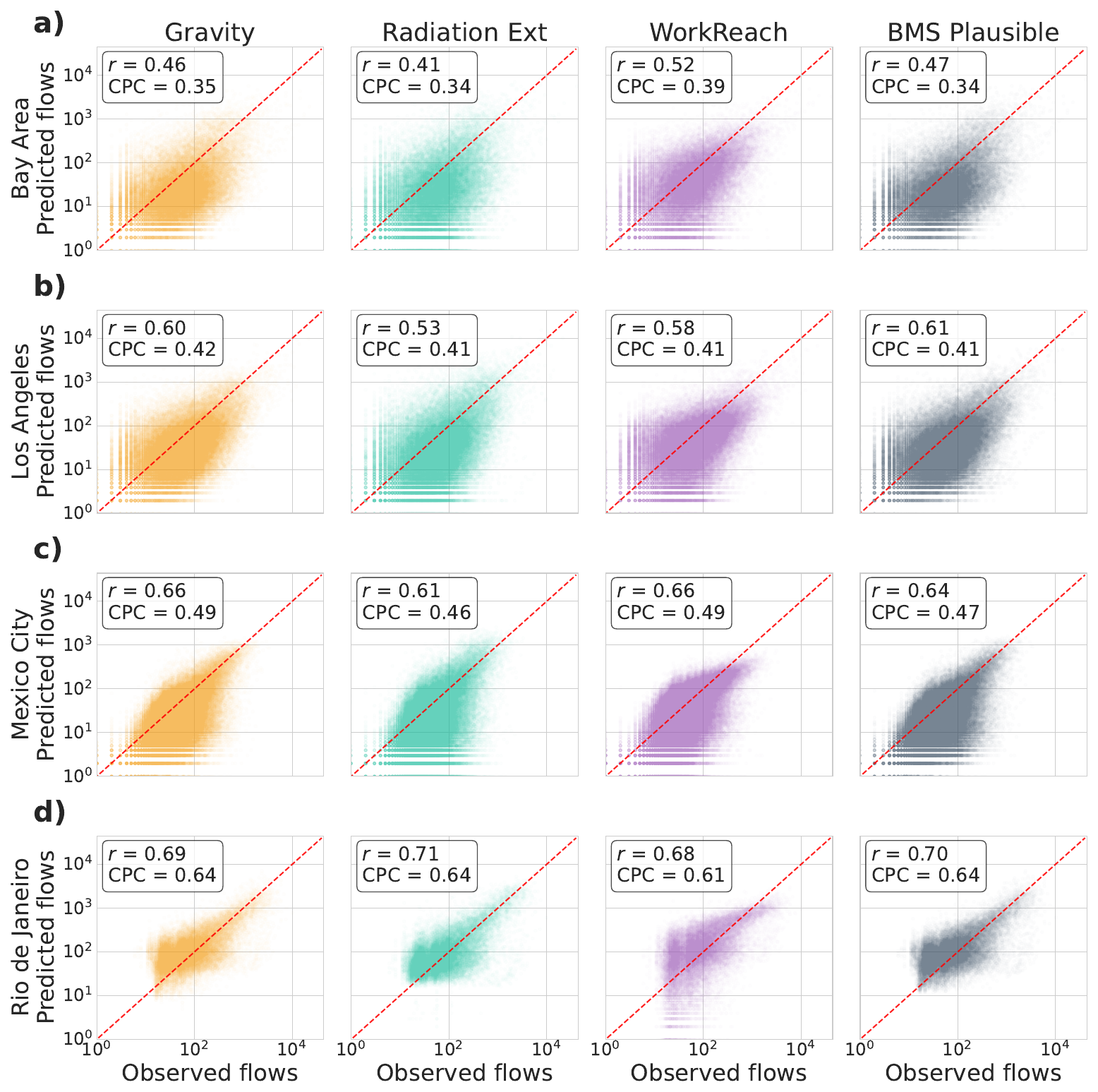
Observed trips against the trips predicted by each model. The closer to the red line, the better.
Being close is not the same as having access
Here comes the part that for me is the most important. Access to jobs is usually measured by looking at how close jobs are to you. But with WorkReach we can measure something more complete, which is how good the whole menu of job options you have from your home is, taking into account distance, the complexity of each area, and the informality of where you live. This is called consumer-surplus accessibility.
When we compare the two measures we find very different things. In the U.S. cities, areas with more informality seem to have better access if we only look at distance, but when we take the quality of the opportunities into account they come out behind. In Mexico City and Rio, areas with more informality were already worse off on distance alone. And when we put the two measures together, areas with more informality have less access in all four cities, especially in the peripheries, like the west side of Rio de Janeiro.
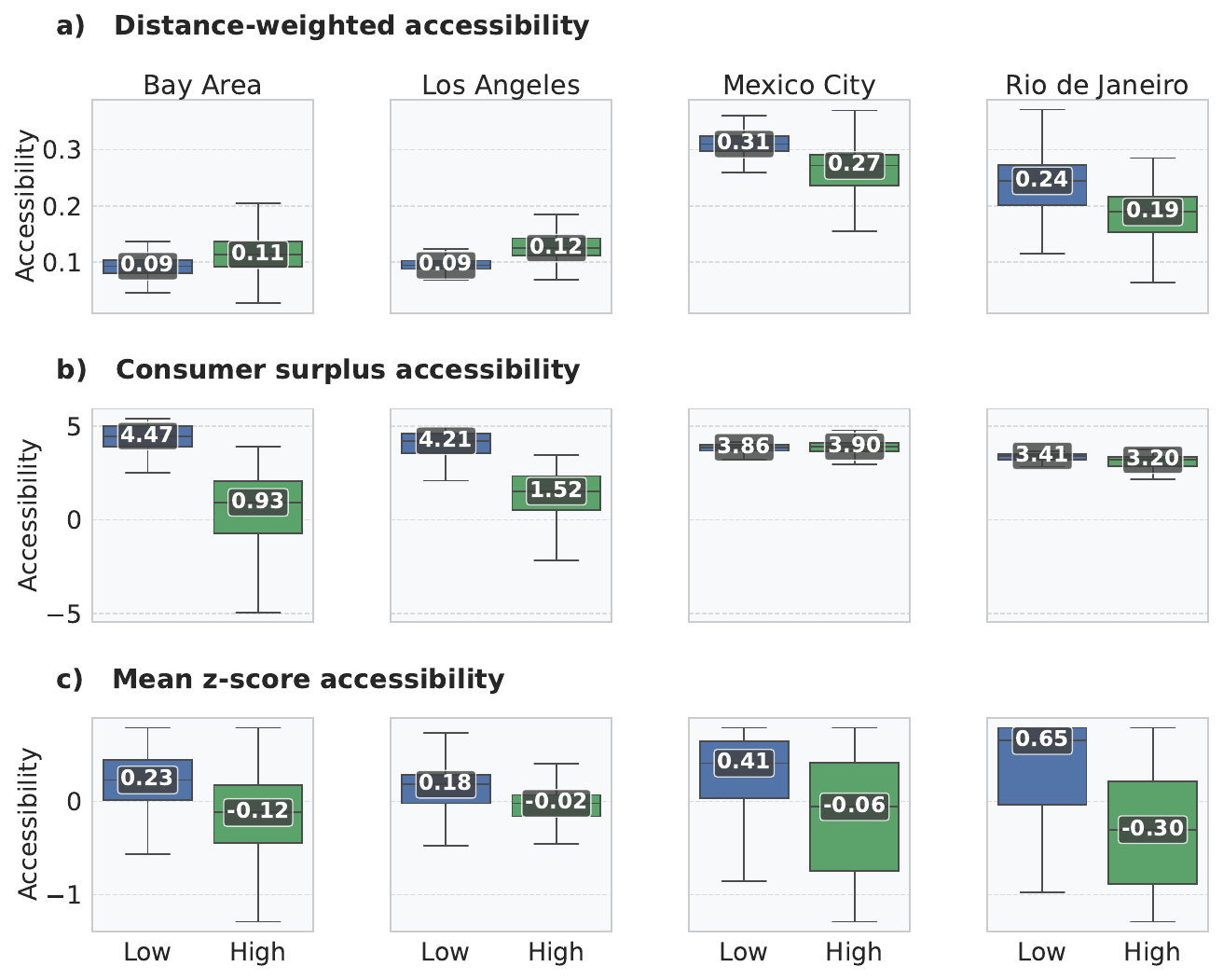
Accessibility of low (blue) and high (green) informality areas, measured by distance, by consumer surplus, and combining the two.
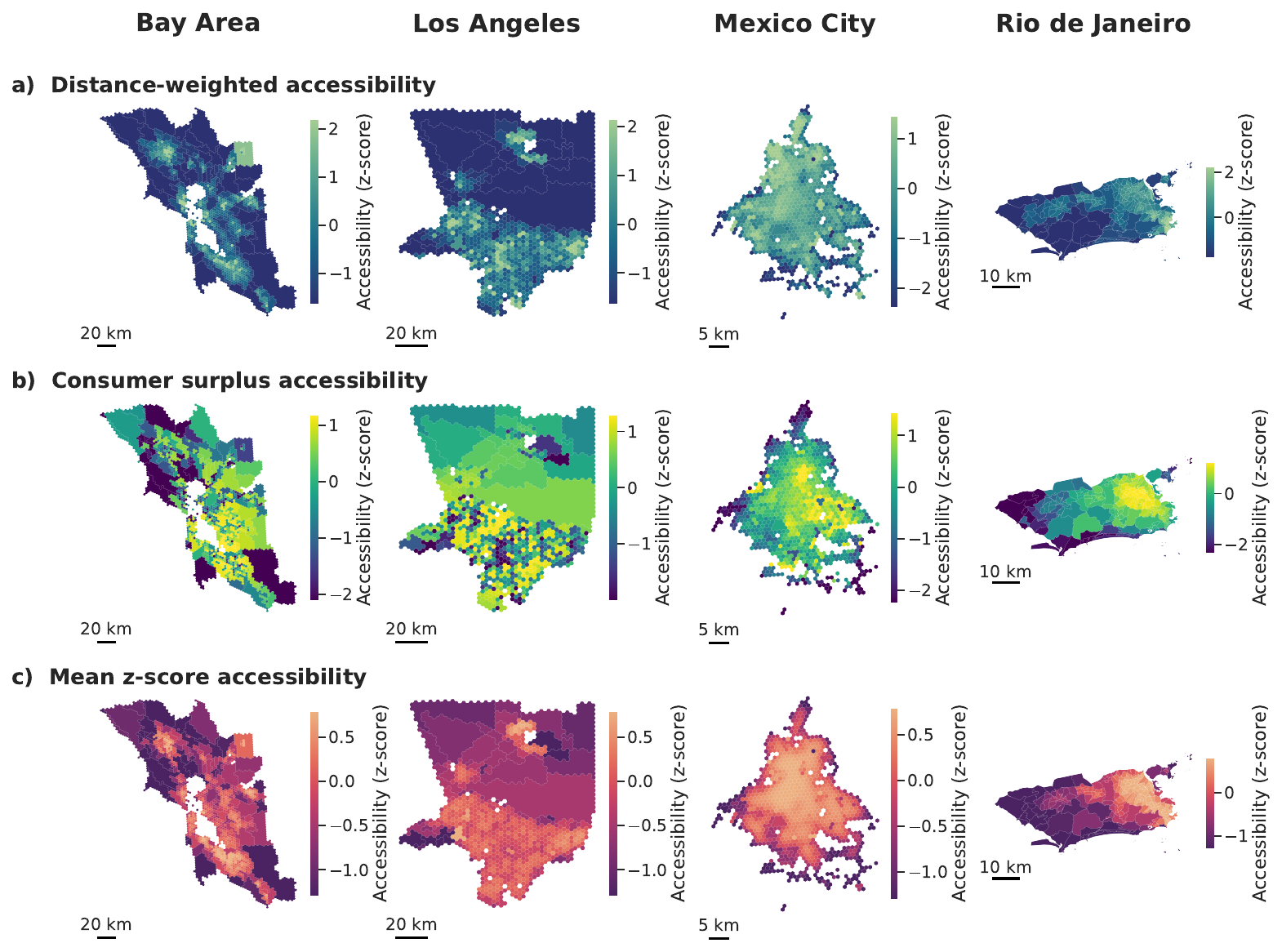
The same measures on the map. The darker areas are the ones with less access.
In other words, living close to where the jobs are doesn't guarantee access to good jobs. If we only measure distance, we might be missing some very important inequalities.
So what is this useful for?
For me the most useful thing about WorkReach is that it helps us think about different policies for each city, instead of one recipe for all of them. In Mexico City and Rio it makes a lot of sense to better connect the peripheries with the high-complexity centers, but that alone isn't enough, because if we don't also create formal jobs and more economic complexity close to where people live, all we achieve is making people travel even more. In the U.S. cities, on the other hand, the barrier doesn't seem to be distance, so it probably works better to invest in training and in removing discrimination barriers.
It also helps us decide where to invest. Areas with a lot of economic complexity but little access for the most vulnerable people are good candidates for better public transit, and areas with good access but little complexity are good candidates for local economic development programs. In the end, what I'd like is that when we talk about access to jobs we don't stop at how far they are, but also think about how good the jobs people can reach actually are.
Paper: Langle-Chimal, O. D., Knoblauch, S., and González, M. C. "The WorkReach model for urban work location choices through economic complexity and informality." Nature Communications (2026). doi:10.1038/s41467-026-78293-3